

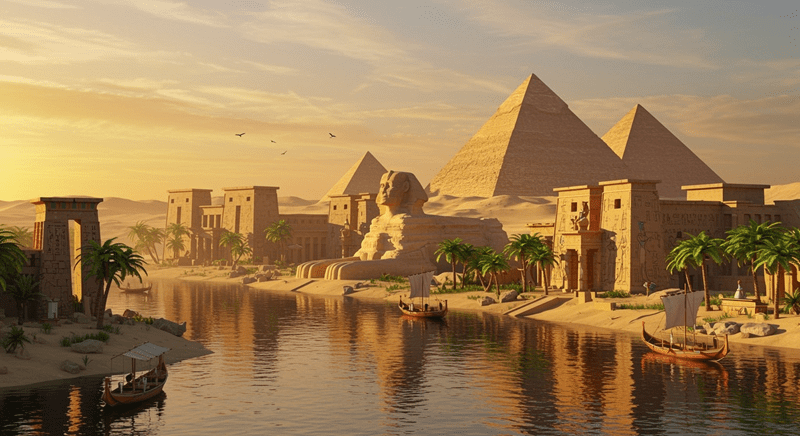
Egypt remains one of the most captivating civilizations in the history of mankind. With its mighty pyramids and sophisticated hieroglyphics, ancient Egyptian society fascinates historians and learners in the USA to date. The significance of this particular civilization does not lie in its architecture alone but in the sophisticated social structure and rituals that made life in the Nile Valley the way it was for such a long period of time.
The Egyptian culture guide provides a comprehensive and interesting description of the culture of the ancient Egyptians, concentrating on the most significant fields for them, including daily life in ancient Egypt, the beliefs of the Egyptians, and the eternal Egyptian traditions.
The Nile streamed through the land reliably and predictably and influenced the culture’s patterns for agriculture, transportation, religion, and habitat. Unlike other ancient civilizations that struggled with the challenges of an unstable environment, the Egyptians enjoyed the luxury of rich soil and geographic isolation that enabled the evolution of a rich and homogeneous culture.
In Egyptian society, there was a strict organization, with the pharaoh at the top. The pharaoh not only served as the governor but also as the god who kept balance, which was referred to as "ma'at." The balance, order, and concept of morality, law, and Egyptian culture influenced how Egyptians behaved in their personal lives.
Religion, family, and work were intricately intertwined, and the ancient Egyptian culture formed an integrated whole instead of fragmented aspects. Travelers can explore a Nile River culture guide for more details about this concept.
To understand the everyday life of the people in Egypt, this information is very useful in giving life to the Egyptian civilization beyond their pyramids and temples. The majority of people in Ancient Egypt were farmers who lived in villages close to the Nile River.
The homes were made up of mud bricks and were designed to be cool. The family was an integral part of life in ancient Egypt. Families comprised extended members. Marriage was prevalent, and women enjoyed more rights than women from other ancient civilizations. They had the right to property and could seek divorce.
The children were valued and educated according to social class. While the majority acquired skills at home, elite children had the opportunity to attend scribal schools and were thus equipped to take up administrative positions.
Bread and beer represented the basic diet, together with vegetables, fish, and meat occasionally. Clothes were lightweight and made of linen. Accessories and make-up were common among all social classes.
Music, games, and stories were some of the forms of entertainment that existed, which indicates that life in ancient Egyptian society was not just centred on work and survival.
Social stratification was characteristic of ancient Egyptian society. The pharaoh was at the head of the system, then the priests, the nobility, the scribes, the artisans, the merchants, and below them the farmers. The majority of the people fell into the last category.
Scribes were a vital part of Egyptian society because literacy rates were very low. Scribes were highly sought after because of their ability to read and write hieroglyphics. This organized society allowed Egyptian culture to remain preserved for many generations, even through times of political chaos.
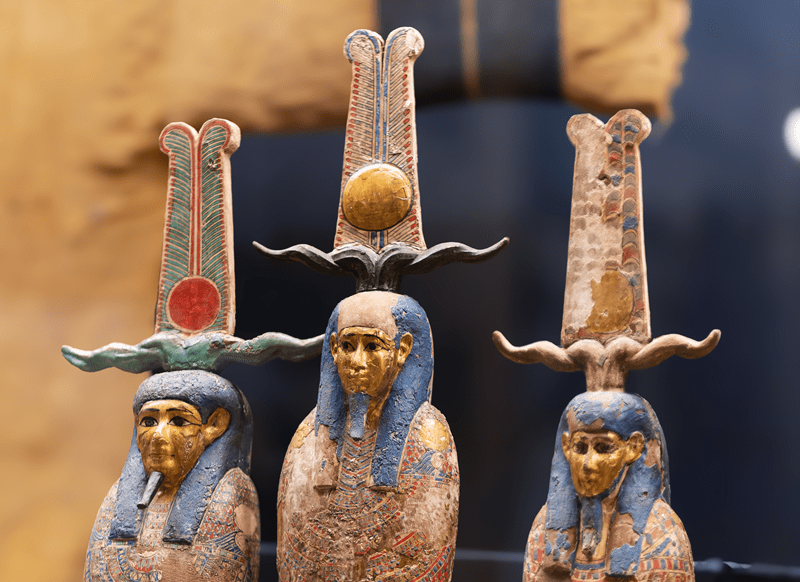
One of the most defining aspects of the culture of the Egyptians was their religion, which impacted every facet of living and, of course, death. The Egyptians believed in a myriad of gods, every single one of them associated either with a phenomenon in nature or a human experience.
Among the most revered gods were the following: Ra, the sun god; Osiris, the god of the afterlife; Isis, the goddess of healing and motherhood; and Anubis, the god who protected the dead. The gods were not remote personalities. Rather, they are thought to be actively influencing occurrences in the lives of ancient Egyptian society.
One of the main aspects of the Egyptian religion was the belief in the afterlife. The Egyptians believed that there was life after death if the soul passed the tests inside the Hall of Ma’at. This practice resulted in the construction of elaborate burial rituals and the building of grave compartments that contained provisions for life after death.
Mummification is easily one of the most iconic Egyptian traditions, and it is embedded heavily in religious practices. This is especially crucial considering that the Egyptians thought that their souls required their bodies for survival in the afterlife.
The tombs were supplied with provisions such as food, clothing, and tools, as well as texts such as the Book of the Dead. All this shows the transition aspect that the culture of the ancient Egyptians considered when it came to death.
Festivals were a significant part of maintaining Egyptian traditions. Religious festivals were held to celebrate gods through music, dance, rituals, and processions. These festivals gave Egyptians an opportunity to associate with gods.
One of the major festivals held during this period is the Opet Festival, also known as the Festival of the Junction, where the renewal of kingship was celebrated, and the renewal of kingship and the cosmic order were observed.
Art and literature were more than just aesthetic. Art and literature were utilitarian and spiritual. The arts in Egyptian culture adhered to strict guidelines, which reflected order and simplicity. The often-made scenes found within the artwork included scenes of everyday Egyptian lives, rituals, and the afterlife.
The hieroglyphic system of writing was a revered means of communication because it was thought to be a gift of the gods. The hieroglyphic system of writing included histories, prayers, and laws, thereby maintaining Egyptian traditions as well as Egyptian beliefs.
The position of women was respectable within Egyptian society. They could own real estate, operate businesses, or be priestesses. Queens such as Hatshepsut ruled actively as pharaohs, thus making it clear that there was no monopoly on leadership over males.
In the daily life of ancient Egyptians, women dealt with the management of homes, bringing up children, and participating in the priesthood. The legal and social rights that women enjoyed were interwoven with concepts of harmony among Egyptians.
The impact of ancient Egyptian culture goes well beyond the ancient era. Contemporary architecture, medical science, artistic expression, and religious teachings have all been inspired by and based on ancient Egyptian civilization. Museums throughout America display relics of daily life in ancient Egyptian culture, which allow contemporary culture to engage with ancient times.
The modern fascinations with mummies, pyramids, and mythology stem from the enduring fascination with Egyptian traditions and Egyptian beliefs. Such components continue to influence current culture and education.
Examining the ancient Egyptian society provides insight into the ways in which cultures are structured around common ideologies and values. Notions of balance and respect for life are certainly lessons that have not aged well.
Through studying the lives of ancient Egyptian citizens, the Egyptian belief systems, and the Egyptian traditions, we are able to better understand the importance of one of the most influential societies in the human experience.
The ancient Egyptian civilization was much more than the pyramids and the pharaohs. This society was based on a strong sense of values and traditions. The ancient Egyptians were able to create a society where they achieved a balance between their worldly lives and their religious faith.
Going back to the rhythms of ancient Egyptian life, and moving on to ancient Egyptian beliefs about the afterlife, right through to the festivals and traditions of the Egyptians, the ancient Egyptians remain an endless source of insight and education. The Egyptians demonstrate that culture, when rooted in commonly held beliefs, can endure for upwards of four millennia.
Ancient Egyptian civilization could be characterized by its close tie with its religious beliefs, social organization, and nature, particularly the Nile. Egyptian beliefs in concepts of "ma’at," life after death, and the pharaoh as a god influenced Egyptian legislation, art, and social interactions. Egyptian practices like celebrations, burial ceremonies, and family-based living contributed to sustained cultural stability for so many years.
The daily life of ancient Egyptians revolved around agriculture, family, and religion. Agriculture remained the main occupation of the ancient Egyptians. They were peasants, artisans, and laborers, and their activities were based on the cycles of the Nile. The housing was modest, the food simple but healthy, and the social life significant. The religion and beliefs of the Egyptians were an integral aspect of their day-to-day activities.
The Egyptian belief system believed that there was life after death. This meant that ethical conduct was crucial. Egyptians thought the judgment of their hearts during their afterlife depended on the manner in which they lived during their lifetime. This practice is central to numerous Egyptian traditions, such as mummification.
This content was created by AI